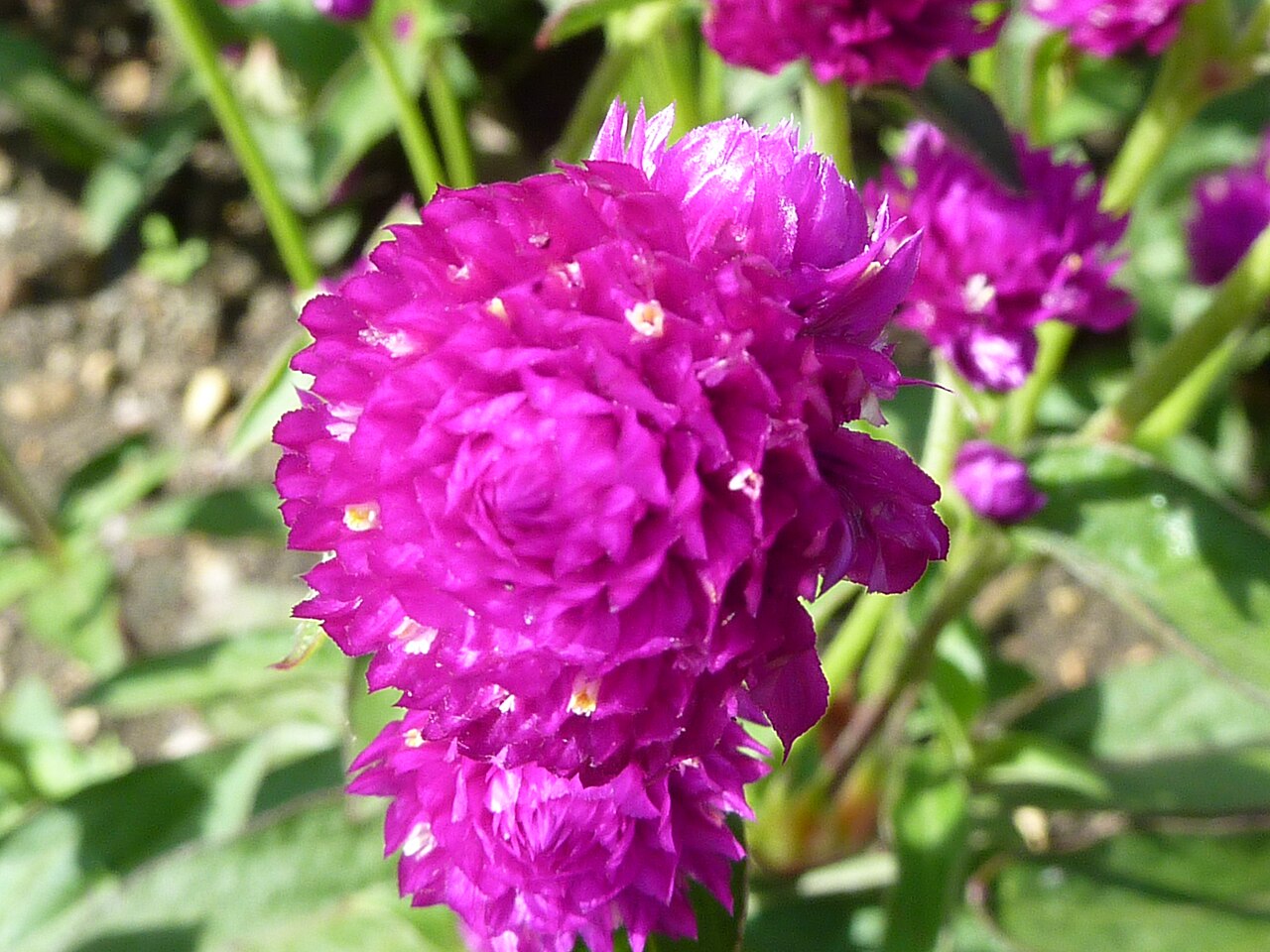
Globe amaranth is a warm-season annual valued in beds, borders, containers, and dried arrangements. Heat tolerance is not the same as needing no water: success begins with drainage, a careful establishment phase, and observation of the garden you actually have.
1. Why it merits a small hot-garden trial
University of Florida IFAS describes globe amaranth as a full-sun annual for moderately dry soil that resists heat and should not be overwatered. Illinois Extension says it holds up under heat, humidity, and rain and needs water when very dry conditions persist. That supports a resilient summer-annual trial; it does not guarantee every cultivar in every courtyard.
Our Saudi-climate inference is deliberately narrower: gomphrena is a reasonable candidate for a sunny test bed, not automatically for a black pot against a west-facing reflective wall in peak August. Trial a few plants first and let their response in your exact microclimate determine whether you repeat them at scale.
Evidence versus inference: extension sources support heat and moderate drought tolerance. The best Saudi planting window and exposure still depend on cultivar, site, and establishment timing.
2. Buy the botanical name and mature habit—not colour alone
Look for Gomphrena globosa on the seed packet or plant label. Flower heads may be purple, pink, white, or yellow, while cultivars vary in height and fullness. IFAS lists a typical height of roughly 30–60 cm and spacing around 30–45 cm, but the cultivar label is the more precise instruction for your plant.
Choose compact transplants with sound foliage and roots that are not densely circling the pot. If starting seed, treat it as a separate experiment and record sowing and emergence dates. Do not buy a whole border until light and drainage have passed a small test.
- Botanical name
- Cultivar and expected height
- Healthy foliage
- Roots not tightly pot-bound
- Plant label retained
3. Design a site that sheds excess water and moderates extremes
Use strong light, moving air, and obvious drainage. In a ground bed, watch where a test watering travels. In a container, use real drainage holes and do not leave the pot standing in a full saucer. Tolerance of several soil textures does not make saturated roots safe.
In Riyadh, morning sun with protection from reflected west-wall heat can be a safer first setting than moving a tender nursery plant directly to the harshest spot. That is a practical microclimate precaution, not gomphrena-specific trial evidence. Acclimate the transplant gradually and watch for wilt that remains the following morning.
- Strong light
- Free drainage
- Air between plants
- No permanent water in saucers
- No untested reflected-heat trap
4. Water for establishment, then read the soil—not the calendar
After planting, wet the root zone appropriately and inspect the soil before the next cycle. Young plants need closer attention while establishing; settled plants can accept a drier interval. Do not turn “drought tolerant” into neglect, or “summer flowers” into automatic daily watering.
Separate dry soil, temporary midday wilt, and persistent wilt in wet soil. The last pattern can point to a root or drainage problem, so more water is not a safe default. Check emitters, soil, and roots and seek local horticultural help if decline persists.
We do not prescribe minutes or litres. Pot volume, soil, wind, heat, and irrigation hardware can change demand radically.
5. Give one bed three jobs: colour, edging, and dried flowers
Repeat gomphrena near the front of a bed, group it in a broad container, or use it as a low seasonal edge. Leave visible space at planting instead of crowding for an instant photograph; spacing also lets you inspect soil and emitters.
IFAS notes that stems can be cut for drying just before flower heads are fully open. Use clean snips, harvest a small batch, and hang it somewhere dry and ventilated away from direct sun. Treat this guide as ornamental only: do not use any part for food or tea based on a common name or social-media claim.
- A 3–5 plant trial
- One repeated colour
- Access to inspect emitters
- Weekly photo from one angle
- Scale-up decision after 3–4 weeks
Affiliate links · Amazon.sa
Two optional tools for recording and cutting; use what you already own first.
As an Amazon Associate I earn from qualifying purchases. We use no retailer images or unverified prices, and commission does not determine editorial selection. Disclosure.
Sources and limits
University extension guidance and the image licence were checked on 6 August 2026. Applying US extension evidence to Saudi gardens is a cautious editorial inference that still requires a local trial. This article gives no pesticide, fertilizer-dose, or fixed irrigation prescription.